Cold Spring School District logoCold Spring Innovation Plan

Measuring Success

What we will measure — and how we'll know.

Test scores matter. So do curiosity, kindness, and confidence. Below are the categories we will track as our AI and innovation work grows.

Featured in The New York Times · May 13, 2026

Cold Spring is off the charts.

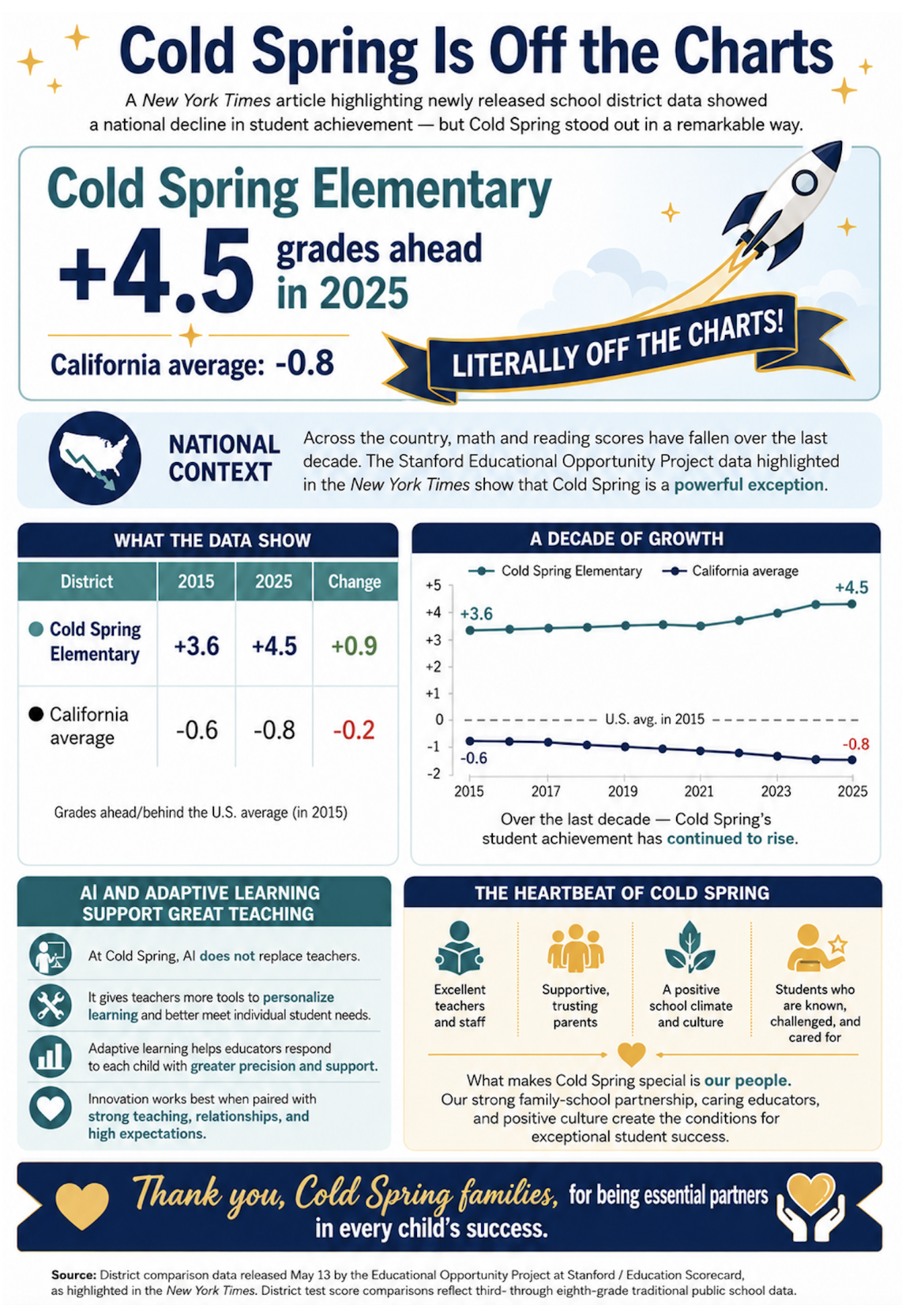
On May 13, 2026, The New York Times highlighted newly released school district comparison data from the Stanford Educational Opportunity Project. While national student achievement declined over the past decade, Cold Spring Elementary stood out — quite literally, off the charts — at +4.5 grade levels ahead of the U.S. average, compared with a California average of −0.8.

This recognition reflects what our community makes possible every day: excellent teachers, supportive families, a positive school culture, and students who are known, challenged, and cared for.

Infographic showing Cold Spring Elementary at +4.5 grade levels ahead in 2025 versus a California average of −0.8, based on Stanford Educational Opportunity Project data highlighted by The New York Times.

Source: District comparison data released May 13, 2026 by the Educational Opportunity Project at Stanford / Education Scorecard, as highlighted in The New York Times. District test score comparisons reflect third- through eighth-grade traditional public school data.

Student Learning

What we will measure
Grade-level growth in reading and mathematics, plus classroom evidence from project work.
How evidence will be collected
CAASPP Summative assessments; Renaissance Learning Star Math and Reading baseline and benchmark assessments; teacher-scored design projects; and classroom evidence.
When results will be reviewed
State assessment cycle; Star benchmarks each trimester.

Student Voice and Agency

What we will measure
How consistently students share their own ideas, curate their own work, and reflect on their own growth.
How evidence will be collected
Student reflections, student surveys, student-led projects, and showcases.
When results will be reviewed
Trimester reflection cycles; end-of-year showcases.

Teacher Impact

What we will measure
Whether AI tools are meaningfully returning time to teaching and strengthening differentiation.
How evidence will be collected
Documented preparation time saved, instructional differentiation examples, professional-learning participation, and teacher feedback.
When results will be reviewed
After each professional-learning cycle; annual review.

Parent Confidence

What we will measure
How informed and confident families feel about AI use with their children.
How evidence will be collected
Family surveys, workshop participation, questions received, and understanding of district safeguards.
When results will be reviewed
Family surveys once per year; workshop feedback after each session.

Responsible Use

What we will measure
How consistently students and staff apply Cold Spring's digital citizenship and privacy expectations.
How evidence will be collected
Digital-citizenship learning, attribution practices, privacy compliance, and incident review.
When results will be reviewed
Ongoing; formal review annually.

Innovation and Creative Growth

What we will measure
The breadth and depth of student creation across writing, coding, robotics, design, and collaboration.
How evidence will be collected
Robotics and coding projects, collaboration, problem solving, and student reflection.
When results will be reviewed
Trimester project reviews; annual roll-up.

Three Ways We See Learning

Evidence of Learning in Three Ways

No single number tells the story of a Cold Spring student. We look at three kinds of evidence together — because independent thinking, creation, and character all matter.

Independent academic performance

How well students read, write, calculate, and reason without AI assistance — including CAASPP, Renaissance Star Reading and Star Math, and teacher-scored classroom work.

Applied creation and problem solving

What students produce when they combine their knowledge with tools — coding projects, robotics missions, Suno compositions, design work, and collaborative problem solving.

Character, voice, and habits of mind

How students think, listen, revise, and treat one another — reflection, kindness, curiosity, responsibility, and their ability to explain and defend their own thinking.

See how we think about success.

A short look at how Cold Spring is approaching measurement, growth, and student voice.